
Book of Dead at Conquestador Casino: Structural Overview for NZ Players
Book of Dead remains one of the most recognisable adventure-themed slot titles in the online market. Its long-term relevance is not based on visual complexity but on structural clarity. The game is built around a straightforward reel layout, a clearly defined bonus mechanic, and volatility that produces uneven but potentially significant outcomes. For Conquestador Casino, featuring this title prominently reflects a strategic choice: players in New Zealand often gravitate toward familiar high-volatility benchmarks rather than experimental mechanics.
The appeal of Book of Dead lies in predictability of rules combined with unpredictability of results. The base game is stable and repetitive in rhythm, while the bonus feature creates sharp variance. That contrast defines the experience. NZ players who prefer defined gameplay structures over heavily layered interfaces often return to this title because it does not attempt to disguise its risk profile.
From a product perspective, Book of Dead serves as a technical benchmark. If it loads quickly, runs smoothly on iPhone and iPad, and maintains stable balance updates, the platform earns credibility. Mobile performance is not secondary in New Zealand; it is primary. A slot that performs inconsistently on handheld devices loses trust immediately.
Core Game Structure and Mechanics
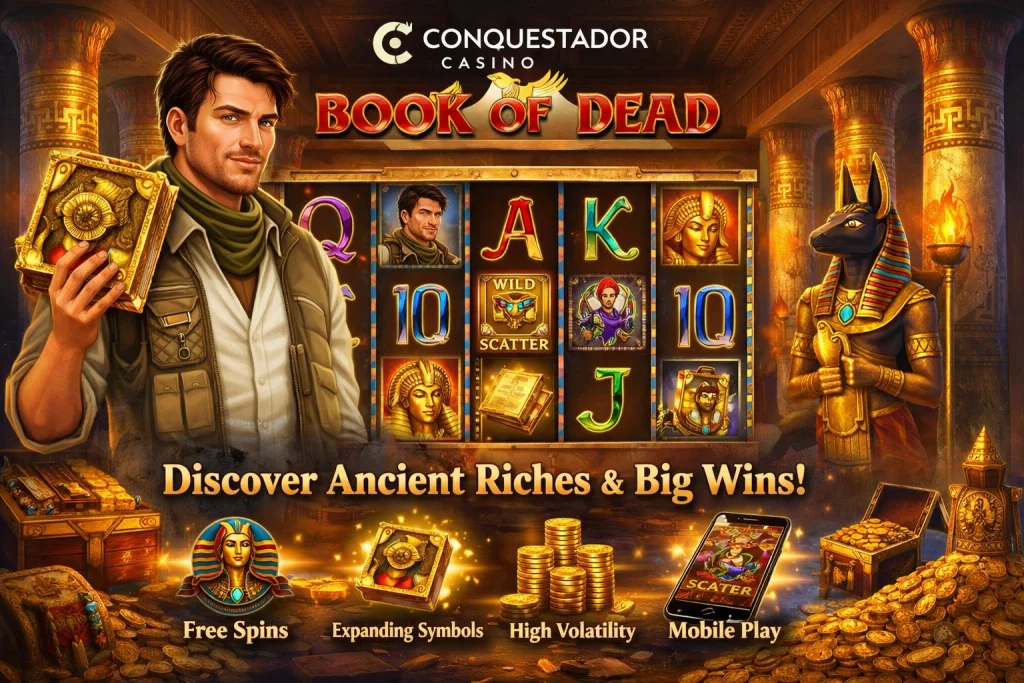
Book of Dead is built on a classic five-reel, three-row configuration with fixed paylines. The visual design is intentionally restrained. Instead of relying on multiple mini-features, it centres engagement around one decisive mechanic: free spins with a randomly selected expanding symbol.
During the base game, wins tend to be moderate and intermittent. The slot does not flood the screen with constant low-value hits. This pacing is deliberate. The anticipation cycle builds around scatter symbols that trigger the bonus round. When three or more scatters land, the free spins sequence begins, and one symbol becomes designated as the expanding symbol for the entire feature.
If that symbol appears during free spins, it expands vertically to cover the reel. When multiple reels expand simultaneously, payout potential increases dramatically. However, if expansions do not align across consecutive reels, the feature may conclude with modest returns. This volatility pattern defines the emotional rhythm of the game.
Understanding this distribution logic is essential. Book of Dead is not engineered for steady incremental gain. It is engineered around feature-driven spikes.
Volatility Profile and Player Behaviour in NZ
Book of Dead is commonly classified as high volatility. In practical terms, this means longer quiet stretches in the base game and heavier reliance on bonus performance. For players in New Zealand, where mobile sessions are often shorter and fragmented throughout the day, this volatility profile can influence perception.
Short sessions may repeatedly capture the low-activity segments of the variance cycle. That does not indicate malfunction. It reflects distribution spread over time. High-volatility slots reward patience but also demand bankroll discipline.
Responsible session framing becomes particularly important. A player who approaches the game without a predefined stake strategy or stop condition is more vulnerable to reactive decisions after bonus rounds underperform. Conversely, a player who sets limits and understands the variance model will experience the slot as designed rather than as unpredictable chaos.
Conquestador Casino should therefore position Book of Dead transparently: not as a “frequent win” slot, but as a structured high-variance title.
Mobile Performance Expectations for New Zealand Users
In the NZ market, mobile access dominates online casino behaviour. Players frequently move between Wi-Fi and mobile data, and device generations vary widely. Therefore, Book of Dead must perform consistently across different iOS models.
Performance expectations include:
– Fast initial loading
– Smooth reel animation without frame drops
– Immediate balance update after spins
– Stable reconnection if signal fluctuates
If a slot lags during reel expansion or delays payout display, trust declines. High-volatility titles already create tension; technical instability compounds it unnecessarily.
On the Conquestador Casino platform, Book of Dead should feel identical whether accessed through desktop browser or mobile App environment. Parity between interfaces reinforces confidence.
Navigation flow should also be intuitive. A returning player may enter through Login, while a new player might begin with Sign Up before exploring the lobby. The slot category is typically accessed under Slots, within the broader Games navigation. Promotional eligibility for Book of Dead sessions may be reviewed under a relevant Bonus section. Informational or regulatory references might appear within curated Links, and common support clarifications are typically answered inside the FAQ section. Each navigation element should appear once, clearly, without clutter.
Why Book of Dead Resonates with NZ Slot Audiences
Several characteristics explain Book of Dead’s continued popularity in New Zealand:
First, familiarity. Many NZ players have encountered the title across multiple operators. That recognition reduces onboarding friction.
Second, clarity. The bonus mechanic is easy to explain and understand, even for players who do not engage deeply with slot mathematics.
Third, emotional contrast. The difference between base game pacing and bonus volatility creates memorable sessions. Whether positive or negative, memorable sessions drive return visits.
However, popularity does not eliminate risk. High volatility requires financial discipline. Platforms that present the slot without contextual explanation risk misaligned expectations. Conquestador Casino’s content should therefore combine structural clarity with behavioural transparency.
Table — Book of Dead Structural Profile (NZ Perspective)
| Category | Description | NZ Player Impact |
|---|---|---|
| Reel Layout | 5 reels, 3 rows, fixed paylines | High familiarity |
| Volatility | High variance, feature-driven payouts | Requires bankroll discipline |
| Bonus Feature | Free spins with expanding symbol | Primary engagement driver |
| Mobile Optimisation | HTML5 rendering, responsive design | Critical in NZ mobile-first market |
| Session Behaviour | Quiet base game, volatile bonus cycle | Emotionally uneven but structured |
Bonus Frequency, Probability Perception and Session Dynamics
The defining element of Book of Dead is the free spins feature with a randomly selected expanding symbol. While the trigger condition is simple — three or more scatter symbols — the behavioural impact of that trigger is complex. Players do not evaluate slots purely on mathematical return; they evaluate them on perceived feature frequency and emotional rhythm.
In high-volatility games like Book of Dead, the bonus may not appear quickly. When it does appear, its outcome distribution varies widely depending on which symbol is selected as the expanding symbol and how it aligns across reels. A low-value symbol expanding across multiple reels can generate surprisingly strong returns, while a high-value symbol that fails to align may deliver only modest results.
For New Zealand players, especially those using mobile devices in shorter session windows, this volatility structure can distort perception. A 10-minute session may not reflect the broader statistical behaviour of the slot. Understanding that distinction reduces reactive decisions.
The correct way to frame Book of Dead is not “How often does the bonus hit?” but rather “How does the bonus change outcome distribution when it hits?” That shift in thinking aligns expectation with structure.
Expanding Symbol Mathematics and Distribution Spread
The expanding symbol mechanic increases payout concentration. During free spins, if the chosen symbol lands on at least one position on a reel, it expands to fill the reel. If this occurs on multiple consecutive reels, the payout multiplies significantly.
This mechanic creates a non-linear payout model:
– Base game = moderate, scattered returns
– Free spins without alignment = controlled variance
– Free spins with multi-reel alignment = payout spike
The result is a wide distribution curve. Many bonuses may deliver moderate outcomes, while a smaller percentage produce session-defining results.
From a strategic perspective, players should treat Book of Dead as a variance-exposed slot. Stake sizing matters more here than in medium-volatility titles because bonus misalignment streaks can deplete a balance quickly.
Session Length vs Volatility Interaction
Session pacing significantly influences player experience. A short session might include zero features. A medium session may include one feature with average return. A longer session increases exposure to statistical variance — both positive and negative.
The following chart illustrates a conceptual relationship between session length and likelihood of encountering at least one meaningful bonus event. The data is illustrative and not a guarantee of outcome, but it reflects volatility dynamics common to high-variance slots.
The purpose of this chart is behavioural illustration. It highlights why short-cycle mobile play can feel less rewarding in high-volatility structures. The mathematics does not favour short exposure windows.
Stake Discipline and Risk Modelling
Book of Dead magnifies the consequences of poor stake sizing. Because the game does not consistently distribute base-game wins, aggressive stake escalation after missed bonuses increases financial volatility.
A structured approach for NZ players typically includes:
– Selecting a stake that allows extended spin capacity
– Avoiding progressive increases after quiet cycles
– Defining a clear stop threshold
– Treating bonus rounds as statistical events, not owed outcomes
When players increase stakes reactively, they distort the volatility model. The game does not compensate for emotional pacing.
Conquestador Casino should present Book of Dead as a high-variance option and encourage structured bankroll logic rather than rapid spin acceleration.
Table — Volatility Impact on Different Player Types
| Player Profile | Session Length | Volatility Impact | Risk Exposure |
|---|---|---|---|
| Short-Session Mobile Player | Low (under 75 spins) | High variance visibility | Moderate to High |
| Moderate Session Player | 100–150 spins | Balanced variance exposure | Moderate |
| Extended Session Player | 200+ spins | Higher statistical spread | High (positive and negative) |
| Reactive Stake Escalator | Variable | Amplified volatility | Very High |
Mobile Performance and Feature Stability
In addition to payout distribution, the bonus feature must execute smoothly on mobile devices. Expanding reels require animation scaling, and lag during expansion undermines perceived fairness. NZ mobile players often use mixed bandwidth conditions; therefore:
– Bonus triggers must load instantly
– Expanding symbols must render without frame delay
– Win calculation should display immediately
– Balance updates must remain synchronized
If technical latency appears during feature rounds, players often misinterpret it as system instability.
Conquestador Casino should ensure Book of Dead is fully optimised across device generations. High-volatility games are psychologically intense; performance friction compounds tension unnecessarily.
Book of Dead in the Competitive Landscape of NZ Adventure Slots
Book of Dead does not exist in isolation. In the New Zealand market, players encounter multiple adventure-style, feature-driven slots that share similar volatility profiles. What differentiates Book of Dead is not complexity but clarity. Many modern slots attempt to layer cascading reels, multipliers, side features, and progressive elements. Book of Dead remains structurally focused: one dominant bonus mechanic that defines the experience.
For NZ players, this simplicity has strategic value. It allows clearer expectation management. A player knows that most of the excitement is concentrated in the free spins feature. There are no hidden secondary systems that distort volatility mid-session.
When compared to newer adventure slots, Book of Dead typically demonstrates:
– Cleaner interface structure
– Faster base spin cycle
– Clearer payout explanation
– Less visual distraction
This matters particularly on mobile, where screen space is limited and excessive visual layers reduce readability.
Comparison with Similar High-Volatility Titles
To evaluate Book of Dead properly, it must be placed beside other high-variance adventure-themed slots available to New Zealand players. The following table outlines structural comparison points rather than marketing positioning.
| Slot Type | Core Feature | Volatility Profile | Mobile Stability Demand |
|---|---|---|---|
| Book of Dead | Free spins with expanding symbol | High | Moderate to High |
| Adventure Megaways Slot | Variable paylines + multipliers | High to Very High | High |
| Cascading Adventure Slot | Avalanche reels + progressive multipliers | Medium to High | High |
| Progressive Adventure Slot | Jackpot integration | Very High | Very High |
The key takeaway for NZ players is that Book of Dead sits in the “controlled high volatility” segment. It does not stack volatility layers on top of each other. Its risk model is concentrated primarily in the expanding symbol mechanic.
Popular Book of Dead-Style Slots Among NZ Players
While Book of Dead remains central, several structurally similar titles attract NZ audiences who prefer feature-focused gameplay:
– Legacy of Dead
– Rise of Merlin
– Reactoonz (high variance cluster format)
– Temple Tumble adventure format
– Gonzo-style expanding reel mechanics
– High-volatility explorer-themed slots
These titles share one common trait: bonus-driven variance. They are not designed to produce constant micro-wins. Instead, they build anticipation around feature triggers.
NZ players often rotate between these slots rather than abandoning Book of Dead entirely. The familiarity of the expanding symbol mechanic provides a reference point when evaluating newer releases.
Volatility Concentration vs Player Retention
Retention in high-volatility slots is influenced by perception of fairness and feature distribution. Players are more tolerant of quiet cycles when the bonus presentation is transparent and technically stable.
The following chart illustrates a conceptual comparison between volatility concentration and perceived engagement over time. The values are illustrative and behavioural in nature.
The chart highlights a behavioural pattern: extremely layered volatility can reduce perceived control, whereas concentrated volatility — as seen in Book of Dead — may actually stabilise engagement because players understand where risk resides.
Mobile Optimisation Compared to Heavier Adventure Slots
One advantage Book of Dead maintains in the NZ market is lighter rendering demand. Slots with cascading mechanics, 6+ reel expansions, or dynamic reel modifiers place heavier load on mobile processors. This increases the likelihood of frame drops on older devices.
Book of Dead, by contrast, requires stable animation primarily during expanding symbol sequences. If properly optimised, it runs smoothly even on mid-generation iPhones. This improves trust.
Performance reliability is especially important during bonus rounds. If expanding reels lag or audio desynchronises, player perception shifts negatively regardless of payout outcome.
Why Book of Dead Remains a Benchmark at Conquestador Casino
For Conquestador Casino, Book of Dead serves multiple purposes:
– It anchors the adventure slot category
– It attracts experienced volatility-aware players
– It tests mobile stability standards
– It supports clear responsible gaming messaging
Unlike more chaotic high-volatility releases, Book of Dead allows structured content explanation. Players know what they are engaging with. That clarity aligns well with New Zealand’s preference for transparency in gambling environments.
Long-Term Sustainability of Book of Dead at Conquestador Casino
Book of Dead is not a novelty release. Its longevity in the New Zealand market is a result of structural consistency rather than visual innovation. For Conquestador Casino, the relevant question is not whether the slot is popular today, but whether it supports sustainable engagement over time.
Sustainable engagement in high-volatility slots depends on three pillars: clarity, stability, and behavioural framing. If a player understands how the expanding symbol works, experiences smooth performance across devices, and encounters transparent stake control options, the game becomes predictable in structure even if unpredictable in outcome.
Predictability of structure reduces cognitive strain. When players do not need to decode complex mechanics, they can make clearer decisions about stake sizing and session duration. This matters particularly in mobile-first markets like New Zealand, where sessions are often short and fragmented.
Behavioural Risk and Player Control
High-volatility slots amplify both positive and negative emotional reactions. Book of Dead concentrates variance inside the bonus feature, which means expectations can escalate quickly. When the bonus underperforms, players may feel the urge to extend the session in anticipation of a stronger feature outcome.
Conquestador Casino should counterbalance this natural volatility effect through interface design and informational transparency. Effective measures include:
– Visible balance tracking at all times
– Immediate access to exit controls
– Clear transaction history
– Simple stake adjustment tools
– Integrated deposit limits
If these controls are accessible without friction, the slot remains entertainment rather than pressure.
In the NZ regulatory context, player responsibility messaging should not appear as an afterthought. It should be embedded within the account environment and slot page explanations. Book of Dead does not need hype language; it needs clarity.
Performance Stability Across Device Generations
One of the strongest strategic advantages of Book of Dead is its moderate rendering demand compared to heavily layered modern slots. The animation requirements are concentrated in the expanding symbol sequence. If that animation executes without frame delay, the game maintains technical credibility.
In New Zealand, where device usage ranges from recent flagship iPhones to older models still in circulation, consistent optimisation is essential. A slot that performs well only on the newest hardware fails to serve the broader audience.
The following table summarises long-term evaluation factors for Book of Dead within Conquestador Casino’s mobile environment.
| Evaluation Pillar | Operational Requirement | NZ Market Importance |
|---|---|---|
| Technical Stability | Smooth animation, no lag during bonus expansion | Critical |
| Volatility Transparency | Clear explanation of high-variance structure | High |
| Responsible Gaming Access | Deposit limits, cooling-off tools visible | High |
| Mobile Optimisation | Consistent performance across iOS generations | Critical |
| Session Predictability | Clear spin rhythm, stable payout display | High |
Comparative Stability vs Overstimulating Slot Models
Modern slot releases often attempt to increase engagement through layered volatility, cascading multipliers, and progressive mechanics. While this may increase short-term excitement, it can reduce clarity.
Book of Dead’s single dominant feature mechanic limits cognitive overload. Players understand that the expanding symbol determines most of the upside. That containment of volatility supports long-term sustainability better than layered risk models.
The following chart conceptually illustrates the relationship between structural clarity and long-term retention perception in high-volatility slots.
The behavioural implication is straightforward: when players understand how risk is structured, they are more likely to engage within limits rather than reactively.
Final Strategic Assessment for NZ Players
Book of Dead remains relevant at Conquestador Casino because it aligns with several NZ-specific priorities:
– Mobile-first optimisation
– Transparent volatility structure
– Clear feature explanation
– Stable rendering across device generations
– Embedded responsible gaming controls
The slot does not promise constant wins. It offers structured variance within a predictable rule set. That combination supports informed participation rather than impulsive engagement.
In the long-term view, Book of Dead functions as a benchmark title. If it performs consistently, displays payouts transparently, and integrates smoothly into the broader Conquestador Casino ecosystem, it reinforces platform credibility.
For New Zealand players, the decisive factors are not theme or nostalgia. They are clarity, stability, and control. When those elements are present, high-volatility slots like Book of Dead can remain part of a balanced entertainment portfolio rather than a source of uncontrolled risk.
Book of Dead Slots – FAQ for New Zealand Players
What type of slot is Book of Dead?
Book of Dead is a high-volatility adventure-themed slot built on a 5-reel, 3-row structure with fixed paylines. The main focus of the game is its free spins feature with a randomly selected expanding symbol, which can significantly increase payout potential during the bonus round.
How do you trigger the free spins feature in Book of Dead?
The free spins round is activated when three or more scatter symbols land anywhere on the reels. Once triggered, the game randomly selects one regular symbol as the expanding symbol for the entire feature, which can expand vertically to fill reels during free spins.
Is Book of Dead considered high volatility?
Yes. Book of Dead is generally classified as a high-volatility slot. This means base game wins may be less frequent, and much of the payout potential is concentrated in the bonus feature. Sessions can vary significantly depending on feature performance.
Is Book of Dead suitable for short mobile sessions?
Because of its high-volatility profile, short sessions may not always include a bonus trigger. Players using mobile devices in short time windows should be aware that the game’s structure often rewards longer exposure rather than brief spin cycles.
Does Book of Dead perform well on iPhone and iPad?
When properly optimised, Book of Dead runs smoothly on modern iOS devices using HTML5 technology. Stable reel animation, responsive controls, and immediate balance updates are key indicators of correct mobile optimisation.
What is the expanding symbol in the bonus round?
During free spins, one standard symbol is randomly selected as the expanding symbol. When this symbol appears on a reel, it can expand to fill the entire reel. If multiple reels expand consecutively, the payout potential increases significantly.
Why can Book of Dead feel “quiet” during base play?
The base game often produces moderate or intermittent wins because much of the slot’s volatility is concentrated in the bonus feature. This design creates anticipation but also means extended quiet cycles are normal within the game’s variance model.
How should NZ players manage bankroll when playing Book of Dead?
Given the high-volatility structure, it is generally advisable to select a stake level that allows for extended spin capacity. Setting session limits and avoiding reactive stake increases after missed bonuses helps maintain control over exposure.
Are there similar slots to Book of Dead popular in New Zealand?
Yes. Several adventure-themed, feature-driven slots with expanding symbols or high-volatility bonus rounds attract NZ audiences. These titles typically emphasise feature concentration rather than constant small wins.
Does Book of Dead guarantee large bonus payouts?
No slot guarantees outcomes. While the expanding symbol feature can produce significant returns, results vary from session to session. Understanding volatility and setting clear limits is essential for responsible participation.